I have a treat for you!
In anticipation of their release of an omnibus of three Shakespearean novelettes, T. O. Tate is allowing me to host a giveaway! They are giving away three copies of the Shardfall omnibus! One on the Patreon, one on my pinned Bluesky post and one on my reading blog. All you have to do is leave a comment either on the blog post or on the Patreon post or the Bluesky post. Comment your favourite Shakespearean work, any work original or reimagined. Any medium. Do not have to be a subscriber or follower, though those are always welcome. I will contact the winner in 2 weeks.
Just now
T. O. Tate is the pen name of author A. Z. Louise, who has an impressive back catalogue of works — short stories, poetry, novelettes, novellas, novels — as well as running Tiny Crow Press, a store for unique and incredible pre-made book covers. Today is the cover reveal for the Shardfall omnibus. So: behold this badass cover!
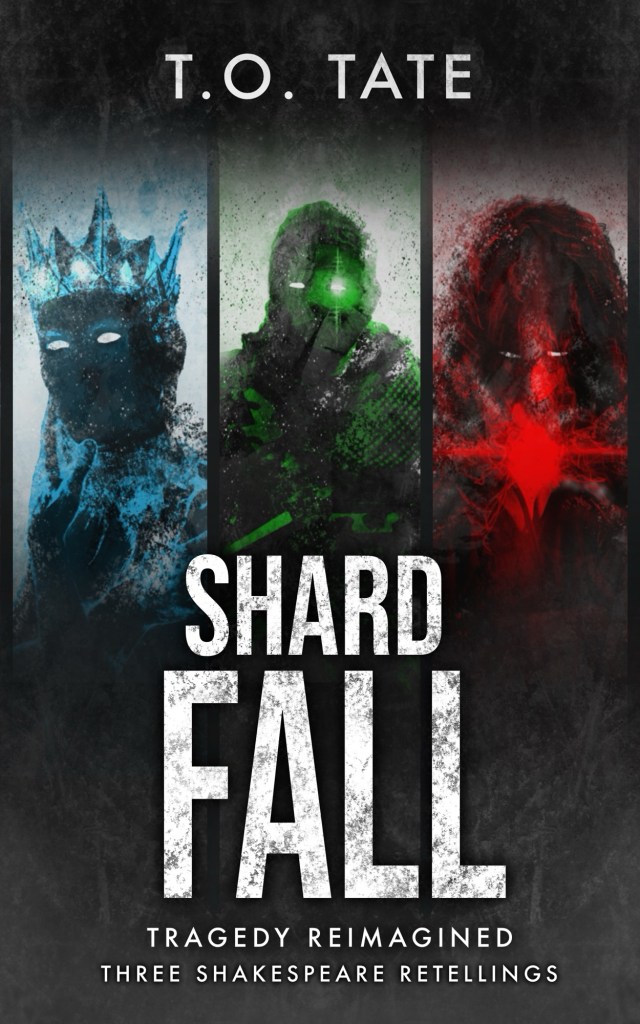
Shardfall: Tragedy Reimagined is an omnibus of three Black, queer post-apocalyptic Shakespeare retellings paired with spot illustrations and sonnets by the Bard.
A Concrete Crown: MacBeth Retold
Micah, a seasoned scout, has seen firsthand the dangers of a desolate city corrupted by a mysterious contaminant, but as the contamination spreads, his cousin Dawson only grows more convinced that it’s safer inside than out. When their battle of wills escalates from argument to blackmail and murder, Micah must ask if his motives are as noble as he wants to believe.
A Starless Eye: Othello Reloaded
Ollie, a former sniper, has been forced into retirement by a mysterious disease known as sliversickness that slowly eats away at her right eye. A perpetual outsider in an isolated underground military base, Ollie’s only solace is her lover, DJ. But that relationship is forbidden, putting Ollie’s already uncertain future in jeopardy, and her only protection is DJ, whose fidelity has been called into question.
A Seething Heart: Ophelia Requited
Orris, afflicted with a mysterious disease called sliversickness since birth, finds themself in the middle of a struggle for power between their lover Hunter and his stepfather Charles. Rumors of ghosts creep through the Squall’s passageways, and Hunter’s behavior becomes more and more erratic. Everyone looks to Orris to help him, worried that he, like so many others, has fallen ill. But as vines begin to stir inside their chest, Hunter kills Orris’s father, leaving vengeance as their only option.
Release date: 10/27/26
But Shardfall here for most ebook platforms and in paperback format. Don’t forget to ask your library to stock it!
For virtual release party details, follow T.O. at https://bsky.app/profile/azlouise.bsky.social, join their brand new event discord at https://discord.gg/XJMrfMn8MC, or sign up for their newsletter: https://dashboard.mailerlite.com/forms/640233/102853824392201664/share